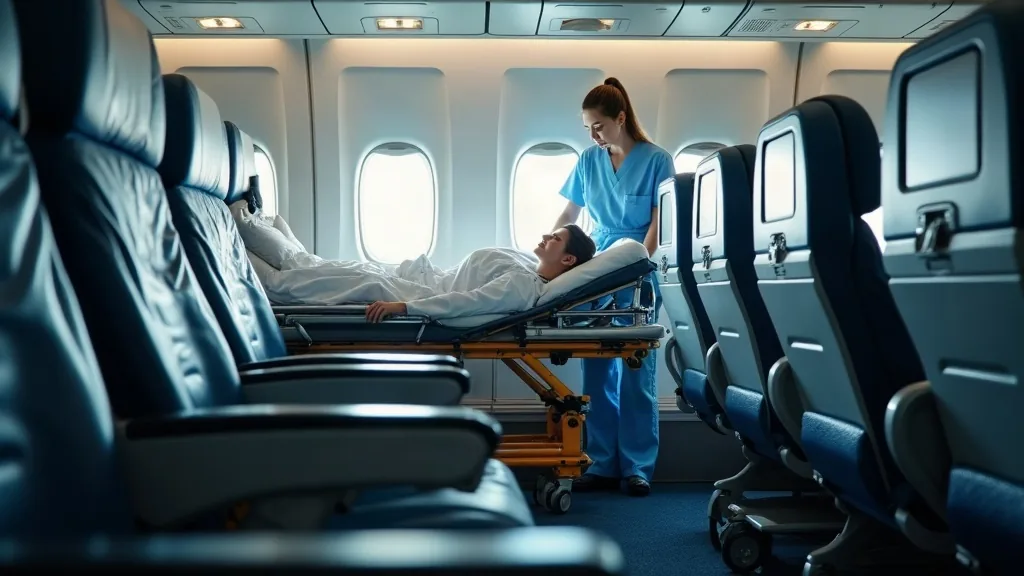
Bali Commercial Stretcher Repatriation
For a medically stable patient, a stretcher installed on a scheduled commercial flight out of Denpasar with a doctor or nurse escort costs roughly USD 5,000-15,000 as of 2026, against USD 50,000 or more for a dedicated air-ambulance flight. The airline needs a completed MEDIF form, a fit-to-fly sign-off, and 48-72 hours’ notice before departure.
Bali Medevac is the coordination desk of Juara Holding Group, an independent broker arranging this tier through vetted licensed airline medical desks, escort clinicians, and ground ambulance partners. We do not operate aircraft, staff the flight, or issue the fit-to-fly clearance ourselves — that sits with the treating hospital and the airline’s own medical department.
What Is Commercial Stretcher Repatriation, and Who Qualifies?
Commercial stretcher repatriation moves a patient home or onward on a regular passenger flight instead of a chartered air ambulance. It works for patients who are stable enough to tolerate cabin pressure and a multi-hour flight without ICU-level monitoring — post-surgical recovery, a stabilized fracture, a controlled cardiac condition, or a patient who no longer needs a ventilator but still cannot sit upright unassisted.
It does not work for patients who are unstable, ventilator-dependent, or need continuous critical care during transit. Those cases require an air ambulance, with costs for routes such as Bali to Singapore or Australia varying significantly and broader trend estimates for Bali-Singapore fixed-wing routes indicating a wide range of costs — the desk presents both bands and dates them, since air-ambulance pricing moves with aircraft availability and route.
Eligibility is decided by the treating physician completing the airline’s Medical Information Form (MEDIF), not by the desk or the family. If the MEDIF comes back declined for commercial transport, the case reroutes to the air-ambulance tier automatically.
How Much Does Each Tier Cost, and What Do You Get?
| Tier | Indicative cost (USD, 2026) | Oxygen on board | Airline notice needed |
|---|---|---|---|
| Escort in a business-class seat | 5,000-8,000 | Portable concentrator, airline pre-approval required | 48 hours minimum |
| Escort with an economy row block | 6,000-10,000 | Portable concentrator, seat-back storage | 48-72 hours |
| Full stretcher, seat rows removed | 10,000-15,000+ | Onboard oxygen cylinder plus escort medical kit | 72 hours or more, aircraft-type dependent |
These bands cover the medical escort, MEDIF processing, and standard airline stretcher-kit fee; they exclude the patient’s own airfare class upgrade where applicable, hospital discharge paperwork fees, and ground ambulance on either end, which the desk quotes separately per route. A commercial air-ambulance guide covering Bali notes that arranging this style of transfer typically takes five to seven hours of coordination work and costs less overall than dispatching a dedicated air ambulance — the saving comes from using scheduled capacity rather than chartering an aircraft.
Which Destinations Can Be Reached This Way, and How Long Does Setup Take?
| Destination | Typical routing from Denpasar | Coordination lead time | Notes |
|---|---|---|---|
| Singapore | Direct flight | 48-72 hours | Most escort-friendly carriers on this route; fastest MEDIF turnaround |
| Kuala Lumpur | Direct flight | 48-72 hours | Comparable process to Singapore |
| Jakarta | Direct, domestic | 24-48 hours | No cross-border customs medical clearance, so setup is faster |
| Perth | Direct flight | 48-72 hours | Subject to daily flight availability |
| Sydney | Direct or one-stop | 72 hours or more | Longer routing adds handling steps at the connecting airport |
Domestic transfers to Jakarta move faster because there is no destination-country medical import clearance to arrange. International legs need the receiving airline’s medical desk, a receiving hospital or family contact at arrival, and sometimes a transit-country clearance if the routing connects through a third airport.
What Paperwork Does the Airline Actually Require?
Every commercial stretcher or escort booking runs through the same four documents, and a missing one is the most common reason a flight gets pushed back a day:
- MEDIF (Medical Information Form) — completed and signed by the treating physician in Bali, stating diagnosis, mobility, oxygen need, and medication schedule. Most airlines require this at least 48 hours before departure.
- Fit-to-fly letter — a separate clearance confirming the patient can tolerate cabin altitude pressure (equivalent to roughly 6,000-8,000 feet), issued by the discharging hospital.
- Oxygen cylinder or concentrator authorization — airlines only accept their own approved cylinder or a listed portable concentrator model; a hospital’s own cylinder generally cannot fly.
- Companion seat booking — one family member can usually sit beside a business or economy-block escort seat; a full stretcher configuration typically allows one companion seat nearby, subject to the aircraft’s stretcher-kit layout.
BPJS and most domestic Indonesian health policies do not fund air-ambulance evacuation abroad and usually exclude foreign evacuation costs outright, so commercial stretcher repatriation is frequently the more affordable path for a family managing the bill directly rather than through a claim.
How Does Booking Work?
- Contact the desk via WhatsApp with the patient’s current hospital, diagnosis summary, and destination city.
- MEDIF request goes to the treating physician — the desk supplies the correct airline form and tracks its completion, usually within 24 hours of the patient being stabilized.
- Airline medical desk reviews the case and confirms which tier (business seat, row block, or full stretcher) the aircraft and route can support.
- An escort doctor or nurse from a licensed partner is assigned, and the fit-to-fly letter is finalized alongside the MEDIF.
- Ground ambulance is booked at both ends — hospital to Denpasar airport, and arrival airport to the receiving hospital or home.
- Final confirmation lands 24-48 hours before the flight, with the companion seat, oxygen authorization, and airline check-in instructions sent to the family.
A 2024 academic review of Indonesian air medical evacuation notes that this kind of cross-border coordination normally runs through the airport health office (KKP), the destination hospital, and the insurer together, under the Ministry of Health’s Decree 882/Menkes/SK/X/2009 and Regulation 14/2021 — rules that define aircraft categories for medical transport but, the same review points out, stop short of a single integrated evacuation procedure. That gap is exactly why a desk that has run the airline-medical-desk conversation before saves a family real time.
Ready to Check Eligibility?
Send the patient’s current condition, hospital, and destination to the Bali Medevac coordination desk on WhatsApp at 6281139414563 or email bd@juaraholding.com. The desk reviews the case against airline stretcher and escort requirements, requests the MEDIF from the treating physician, and comes back with a tier recommendation and cost band — Juara Holding Group is an independent broker arranging licensed partners for the flight, escort, and ground transfer; it does not operate the aircraft or issue medical clearances itself.
Frequently Asked Questions
What is the difference between commercial stretcher repatriation and an air ambulance?
Commercial stretcher repatriation uses a scheduled passenger flight with a medical escort and costs roughly USD 5,000-15,000 as of 2026. An air ambulance is a dedicated aircraft with onboard ICU-level equipment, running USD 50,000-150,000 depending on destination. The choice depends on whether the patient is stable enough for cabin pressure without continuous critical care.
How far in advance does the airline need the MEDIF form?
Most airlines want the completed Medical Information Form at least 48 hours before departure, and a full stretcher configuration with seat rows removed often needs 72 hours or more because it depends on aircraft type and availability. The desk starts the MEDIF request with the treating physician as soon as the case is confirmed stable.
Can a family member fly with the patient?
Usually yes. A business or economy-block escort seat generally allows one companion seat beside it, and a full stretcher configuration typically permits one nearby companion seat, subject to the specific aircraft’s stretcher-kit layout. The desk confirms the exact seating once the airline assigns the aircraft.
Does BPJS or travel insurance cover this kind of repatriation?
BPJS does not fund air-ambulance evacuation abroad, and most domestic Indonesian policies exclude foreign evacuation as well. Commercial stretcher repatriation is often paid directly by the family or a foreign travel insurer with an evacuation benefit, so it is worth checking the specific policy’s repatriation clause before the flight is booked.
What happens if the patient is not cleared for a commercial flight?
If the treating physician or the airline’s medical desk declines the MEDIF, the case moves to the air-ambulance tier instead, since that aircraft carries onboard critical-care equipment a commercial cabin does not have. The coordination desk reroutes the request the same day so the family is not left waiting on two separate processes.