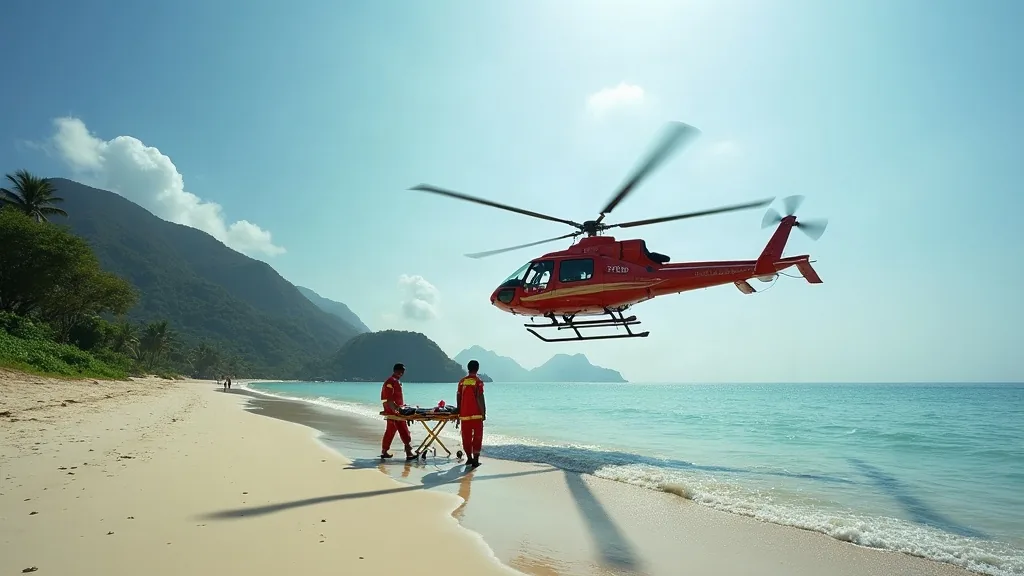
Helicopter lift from Nusa Penida to a Bali private hospital is arranged through licensed helicopter operators serving Bali and the islands, daylight hours only under Indonesian aviation rules, with fast boat plus ground ambulance as the standing fallback for night hours or non-landable zones. The desk coordinates pickup, receiving hospital bed and insurer contact from the first WhatsApp message.
What Are the Nusa Penida Pickup Zones and Their Landing Constraints?
Nusa Penida’s terrain decides the transfer method before price does. Toyapakeh and the harbor strip offer open ground and the fastest road link to the island’s clinic. Crystal Bay allows a beach or open-field landing in daylight. Kelingking and Atuh/Diamond Beach have no formal helipad, so a case there often starts as a road-and-boat evacuation, with a helicopter called to a rendezvous point only if one exists.
| Pickup zone | Landing constraint | Nearest clinic/hospital |
|---|---|---|
| Toyapakeh / harbor area | Open ground close to the crossing point, easiest vehicle access | Puskesmas Nusa Penida, Sampalan, roughly 20-30 minutes by road |
| Crystal Bay | Beach or open-field landing possible in daylight; sea access nearby for boat fallback | Puskesmas Nusa Penida, Sampalan |
| Kelingking | Cliff-top terrain, no formal helipad, steep unpaved access road | Sampalan clinic, roughly 40-50 minutes by road |
| Atuh / Diamond Beach | Remote cliff-and-beach setting, limited vehicle access, longer stabilization window needed before any transfer starts | Sampalan clinic, roughly 60 minutes or more by road |
These are indicative desk figures for 2026 road conditions, not a substitute for a live assessment; the coordinator confirms the nearest usable landing point or harbour once a location pin is shared.
Helicopter or Fast Boat Plus Ambulance: Which Gets Chosen?
The choice comes down to three questions the coordinator asks first: is the patient stable, is it daylight, and can a helicopter reach that specific point on the island. A stroke, cardiac event or major trauma case in daylight, near a landable zone, generally goes by helicopter. A stable patient, a night-time case, or a cliff location such as Kelingking or Atuh usually goes by fast boat to Sanur, Kusamba or Padang Bai harbour, followed by ground ambulance.
| Option | Indicative door-to-door time | Price band (2026, indicative) | Typically chosen when |
|---|---|---|---|
| Helicopter, daylight only | Roughly 45-75 minutes from pickup point to a Bali hospital helipad | Quoted per case by the licensed operator; not a fixed public rate | Life-threatening signs, daylight hours, a zone with usable landing ground |
| Fast boat + ground ambulance | Roughly 2.5-4 hours harbour crossing plus road transfer via Sanur, Kusamba or Padang Bai | Far lower than a helicopter charter; harbour transfer fee plus ambulance fee, both well under helicopter cost | Stable patient, night hours, or a cliff/beach zone without safe helicopter access |
For comparison, BIMC Hospital Bali’s own Emergency Medical Evacuation Program lists IDR 2,925,000 for a single traveller, IDR 4,394,000 for a couple and IDR 5,850,000 for a family, a page BIMC last updated 5 February 2025. That covers a standing membership-style program, not a live Nusa Penida callout, but it anchors what organised Bali hospital evacuation cover costs against an ad hoc helicopter charter quoted per case.
Why Does the Helicopter Option Stop at Sunset?
Indonesian civil aviation rules currently require helicopter operations to end at sunset. That single rule shapes every Nusa Penida case: an incident called in after dark defaults to boat, ground ambulance or overnight stabilization at the island clinic, with a morning helicopter transfer only if the patient’s condition allows the wait. The desk flags this constraint the moment a case comes in outside daylight hours so families are not expecting a night flight that Indonesian operators cannot legally fly.
Sunset cut-off, in practice: a call received at 4pm with a two-hour road-and-boat lead time to a landing point may still make a daylight helicopter window in the dry season; a call received at 7pm goes straight to the boat-and-ambulance path, with the receiving hospital notified for a delayed arrival.
What Happens With Diving Accidents and Decompression Sickness?
Nusa Penida’s Crystal Bay and Manta Point are dive sites, and decompression sickness cases follow a different pathway from trauma. The desk arranges transfer to a Bali hyperbaric chamber rather than a general emergency department; a 2026 Bali/Komodo medical guide prices a single hyperbaric session at IDR 600,000-1,200,000, with multi-day chamber treatment plus ICU care running USD 5,000-30,000 depending on severity. DAN (Divers Alert Network) can be reached directly on +1-919-684-9111 for dive-specific guidance while transfer is arranged. Because DCS cases must avoid further altitude exposure, a helicopter transfer needs low-altitude routing confirmed with the operator first, which is one more reason the desk makes that call, not the traveller.
How Does Booking Work With the Bali Medevac Desk?
- Send location and condition. WhatsApp the pickup zone (Toyapakeh, Crystal Bay, Kelingking, Atuh, or a pin) plus the patient’s condition to 6281139414563.
- Desk assessment. The coordinator checks daylight window, nearest landable point or harbour, and whether the case needs helicopter, boat, or both.
- Operator and hospital contact. The desk calls a licensed helicopter or fast-boat operator serving Bali and the islands and opens a bed request with the receiving Bali hospital.
- Insurer liaison. If the traveller holds evacuation cover, the desk relays policy details to the insurer in parallel so authorisation is not the bottleneck; BPJS does not cover air-ambulance evacuation and most domestic policies exclude it, so this step matters most for travellers on standard travel insurance.
- Transfer and handover. The patient is moved to the Bali hospital or onward repatriation point, with the desk staying on the line until handover is confirmed.
A written quote request can also be submitted ahead of travel for dive trips, villa stays or yacht charters around Nusa Penida, so a standby plan is on file before anything happens.
Ready When You Need It
Bali Medevac is the independent coordination desk of Juara Holding Group, arranging Nusa Penida transfers with licensed helicopter, boat and ambulance partners — not a hospital, insurer or aircraft operator itself. Send your location and condition on WhatsApp 6281139414563 or email bd@juaraholding.com, and the desk starts calling operators immediately, day or night.
Frequently Asked Questions
How much does a helicopter medevac from Nusa Penida to Bali cost?
There is no fixed public rate; each licensed helicopter operator serving Bali and the islands quotes per case based on aircraft availability, distance and time of day. As a reference point only, BIMC Hospital Bali’s published evacuation program runs IDR 2,925,000-5,850,000 depending on traveller count, a different product from a one-off helicopter charter. The desk gets a specific quote once location and condition are shared.
Can a helicopter land at Kelingking or Atuh Beach on Nusa Penida?
Not directly in most cases. Both sites sit on steep, unpaved cliff terrain with no formal helipad, so the standard pathway is road-and-boat transfer to a landable point or Bali-bound harbour, with a helicopter used only if a safe rendezvous zone is confirmed by the operator in daylight.
What happens if a medical emergency in Nusa Penida happens after dark?
Indonesian aviation rules require helicopter operations to end at sunset, so a night-time case defaults to fast boat and ground ambulance via Sanur, Kusamba or Padang Bai harbour, or overnight stabilization at the island clinic if travel is not safe, with a daylight helicopter option reassessed the next morning.
How fast can a fast boat and ambulance reach a Bali hospital from Nusa Penida?
Indicative door-to-door time is roughly 2.5-4 hours, covering the harbour crossing plus road transfer by ground ambulance to the receiving hospital, longer than a daylight helicopter but the standard and lower-cost option for stable patients or night-hour cases.
Does travel insurance cover Nusa Penida helicopter evacuation?
It depends on the policy; BPJS does not fund air-ambulance evacuation and most domestic Indonesian plans exclude it. Some 2026 advisories report a move toward mandatory travel insurance with minimum medical and repatriation limits, which travellers should verify directly with Indonesian immigration before arrival. The desk liaises with whatever insurer is on file once a case opens.