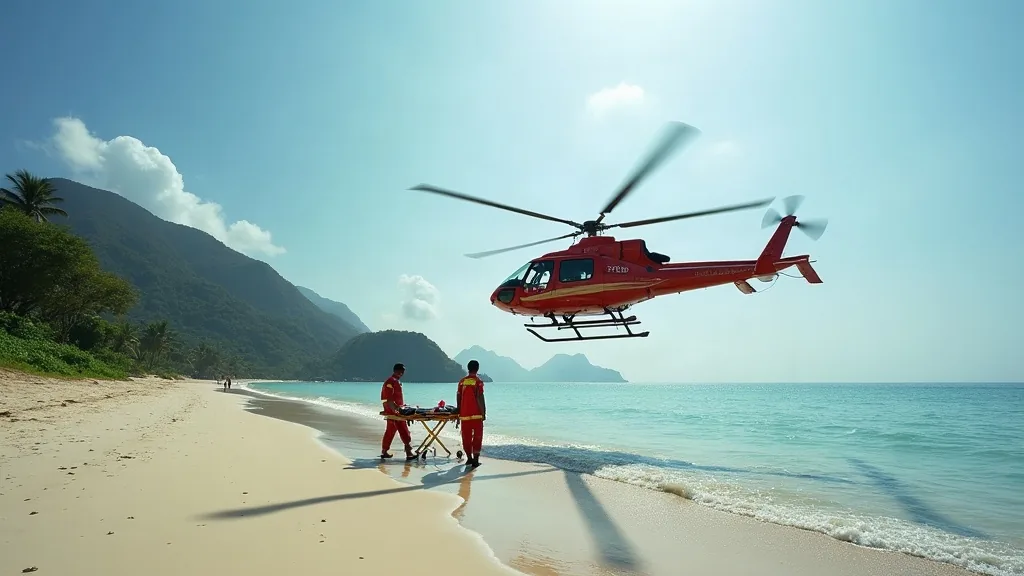
Gili Islands Medical Evacuation
From Gili Trawangan, Gili Meno or Gili Air, the desk weighs two paths off the island: a Heli Medic-type helicopter transfer straight to a Bali hospital, or a boat medevac to Bali’s harbour, which a Gili-focused advisory confirms is cheaper for Gili Trawangan cases. Lombok hospitals serve as the interim stop between.
None of the three Gilis has a hospital. Every serious case — a decompression hit, a drowning, a bad motorbike-free-island fall from a cidomo cart, a cardiac event — starts with the same question: does this patient need a helicopter now, a boat within the hour, or Lombok’s nearest ward first while the desk arranges the rest? Bali Medevac is the coordination desk that answers that question and books the transfer. Juara Holding Group does not operate boats, helicopters or hospitals; it arranges each leg with licensed partners and liaises with the receiving facility and insurer.
Which Gili Are You Evacuating From?
Boat speed, jetty access and the practical option of an open-ground helicopter landing differ island by island. The desk asks for the island name in the first WhatsApp message for exactly this reason.
| Island | On-island medical post | Boat jetty | Helicopter landing option | To Bangsal/Teluk Nare | Fast-boat to Bali harbour |
|---|---|---|---|---|---|
| Gili Trawangan | Largest island; has a walk-in clinic/first-aid post | Main public jetty, departures most daylight hours | No fixed helipad; open ground used case-by-case when an operator is dispatched | Roughly 15-20 minutes by boat | Roughly 1.5-2.5 hours (Padangbai/Serangan/Benoa, sea-dependent) |
| Gili Meno | Smallest and quietest; clinic coverage is thin | Small jetty, fewer daily departures | No fixed helipad; open ground only, subject to an operator’s site survey | Roughly 20-25 minutes by boat | Roughly 1.5-2.5 hours, often routed via Trawangan or Air first |
| Gili Air | Closest to the Lombok mainland; has a basic clinic | Jetty nearest the Bangsal crossing | No fixed helipad; open ground option, shortest run to Lombok emergency services | Roughly 10-15 minutes by boat | Roughly 1.5-2.5 hours, sea-dependent |
None of the Gilis allow cars or motorbikes. A patient typically moves by cidomo (horse cart), bicycle trailer or on foot to the jetty first — the desk factors that leg into the total time it quotes, not just the water crossing.
Boat, Helicopter, or Lombok Hospital First — Which Wins?
| Mode | Typical time, Gili to definitive care | 2026 cost band | Best-fit condition |
|---|---|---|---|
| Boat medevac to Bali harbour | About 5-7 hours door-to-door, per a Bali evacuation advisory updated 18 June 2026 | Below an air-ambulance transfer; charter, medical escort and the Bali-side ambulance are quoted at enquiry | Stable patient, daylight hours, fracture, dehydration, non-critical dive injury |
| Heli Medic-type helicopter, Gili/Lombok to Bali | Flight time under an hour; total door-to-door depends on daylight and aircraft standby | No fixed public tariff for this short hop; the desk quotes per operator, fuel and standby at time of dispatch | Time-critical case: stroke, cardiac event, severe decompression sickness, major trauma, and only within daylight hours |
| Lombok hospital first | Boat to Bangsal/Teluk Nare then a short road transfer, often under two hours from Gili Air | Domestic ambulance and hospital fees, well below a Bali or international transfer | Borderline case where mainland stabilisation avoids escalating to Bali or overseas at all |
Indonesian aviation rules require helicopter operations to end at sunset. An incident on any Gili after dark defaults to boat, road transfer via Lombok, or overnight stabilisation at the nearest clinic until a helicopter can legally fly again at first light.
Why Decompression Sickness Changes the Plan
The Gilis run on dive tourism, and decompression sickness (DCS) is the condition the desk plans for hardest. A diver with DCS symptoms needs oxygen immediately and a hyperbaric chamber evaluation, not a slow multi-hop transfer. DAN (Divers Alert Network) runs a 24-hour dive-emergency line at +1-919-684-9111 for exactly these calls, and the desk expects any dive operator’s insurance paperwork to be on hand before booking the transfer.
Once in Bali, a standard hyperbaric session runs roughly IDR 600,000-1,200,000, and a multi-day course combining chamber time with ICU support runs roughly USD 5,000-30,000, as of 2026. Those figures come from general Bali/Komodo hyperbaric pricing references and should be confirmed with the receiving facility at time of treatment, since chamber availability and case severity both move the final bill.
What Insurance and Government Rules Actually Apply Here?
A 2024 academic review of Indonesian air medical evacuation notes that coordination normally runs through the airport health office (KKP), the destination hospital and the patient’s insurer, under the Decree of the Minister of Health No. 882/Menkes/SK/X/2009 and Regulation of the Minister of Health No. 14/2021. The same review flags a real gap: those rules define air-ambulance aircraft types but do not lay out one integrated evacuation procedure — which is precisely why a coordination desk that has run the KKP/hospital/insurer handshake before is worth more than a single phone number.
BPJS, Indonesia’s national health scheme, does not fund air-ambulance evacuation abroad, and most travellers’ domestic policies exclude foreign evacuation outright. Some travellers already carry a Bali hospital’s own membership cover — BIMC Hospital’s Emergency Medical Evacuation Program, for example, is priced at IDR 2,925,000 for a single traveller, IDR 4,394,000 for a couple and IDR 5,850,000 for a family, per its page last updated 5 February 2025. The desk works alongside that kind of coverage rather than replacing it, and still confirms benefits with the insurer before dispatch.
Two 2026 rule changes matter for Gili-bound travellers specifically. A Jasindo-Sanur Harbor partnership launched in 2026 sells a 24-hour fast-boat passenger policy that covers emergency medical risk on the Sanur-Gili crossing — worth asking your boat operator about before departure, as policy rates apply. Separately, March 2026 Rinjani trekking rules reportedly require trekkers to hold insurance covering helicopter evacuation, relevant if your Gili trip includes a Lombok volcano leg; travel advisories in 2026 have also reported a broader minimum travel-insurance requirement with medical and repatriation limits from July 2026 — treat that as reported and verify current entry rules with Indonesian immigration before you fly.
How Booking Works
- WhatsApp the desk at 6281139414563 with three things: which island, which jetty is nearest, and the patient’s condition.
- The desk assesses daylight window, sea state and severity to recommend boat, helicopter, or Lombok hospital first.
- The desk books the transfer operator, arranges cidomo/boat movement to the jetty, and lines up ground ambulance at the Bali-side harbour.
- Hospital liaison confirms admission in Bali, or hands off to an air-ambulance or commercial-escort repatriation partner if the case needs Singapore, Australia or Jakarta next.
- Insurer and resort/embassy follow-up closes the loop so the family or dive operator isn’t chasing updates alone.
Book the Desk
Bali Medevac is an independent coordination desk run by Juara Holding Group (established 2015) — not a hospital, insurer, helicopter operator or boat company, and not affiliated with any single operator serving the Gilis. Every leg is arranged with vetted licensed partners, priced and confirmed before dispatch. For a live Gili emergency or a standby plan ahead of a dive trip, message WhatsApp 6281139414563 or email bd@juaraholding.com with island, jetty and condition.
Frequently Asked Questions
Can a helicopter land directly on Gili Trawangan, Gili Meno, or Gili Air?
None of the three islands has a fixed helipad. When a helicopter is the right call, an operator uses open ground on a case-by-case basis, confirmed on the day by the dispatching team. That is one reason boat medevac stays the default option, and why the desk always asks which island and jetty before recommending a mode.
Is boat evacuation always cheaper than a helicopter from the Gilis?
For Gili Trawangan cases, a Gili-focused advisory confirms boat transfer runs cheaper than helicopter dispatch, and it is the default recommendation for a stable patient in daylight. A helicopter is still the right call for time-critical conditions such as stroke, cardiac events or severe decompression sickness, where the extra cost buys speed the patient cannot afford to lose.
What happens if a Gili medical emergency happens after dark?
Indonesian aviation rules require helicopter operations to end at sunset, so any incident after dark defaults to boat transfer, a Lombok road transfer via Bangsal, or overnight stabilisation at the island’s clinic until daylight allows a helicopter to fly. The desk plans for this by confirming local time and daylight window as soon as it hears the case.
Does travel insurance cover a Gili Islands medical evacuation?
Coverage depends entirely on the policy. BPJS does not fund evacuation abroad, and many domestic Indonesian plans exclude foreign evacuation. Some travellers hold a Bali hospital’s own membership program instead. Always confirm your policy’s evacuation and repatriation limits before a trip, and have the policy number ready when you contact the desk so it can coordinate with your insurer directly.
How do you reach the jetty from a Gili resort without a car?
The Gili islands ban cars and motorbikes, so patients move by cidomo (horse cart), bicycle trailer or on foot to the nearest jetty. The desk builds this leg into its time estimate rather than assuming a road ambulance can meet the patient at the door, which is part of why response planning differs island to island.